
Start Your Christmas List Early in January and July to Save Money and Stress

The most expensive Christmas gifts are often the ones bought in a panic.
They are the “anything will do” gifts grabbed on December 22, the overpriced shipping fees paid because time ran out, and the last-minute extras bought because someone was accidentally left off the list. By the time November and December arrive, the pressure can turn what should be a joyful season into a stressful race against time and money.
Echo Bazaar endorsses the prudency of starting your Christmas list early, especially in January and July, changes these negative outcomes.
January gives you a clean slate. You can look back at what worked, what cost too much, and who you forgot. July gives you a midyear reset. You still have months to shop, save, compare prices, and plan thoughtful gifts without squeezing your wallet dry.
A Christmas list is more than a list of names. It is a simple plan that can protect your budget, reduce embarrassment, and help you give with more care.

Why January is the smartest time to start your Christmas list
January may feel too early to think about Christmas. The tree may still be up, the wrapping paper may still be scattered, and the last thing many people want to do is plan for the next holiday season.
That is exactly why January works.
The details are still fresh. You remember who surprised you with a gift. You remember which relative was difficult to buy for. You remember the person you almost forgot, or worse, did forget. You also remember how much you spent and whether it felt comfortable or painful.
Waiting until late fall means relying on memory when life is already busy. Starting in January lets you capture the truth while it is clear.
January helps you review what just happened
Before you think about next Christmas, take a few minutes to review the one that just passed.
Ask simple questions:
Who did you buy for?
Who gave you a gift that you were not expecting?
Which gifts were genuinely appreciated?
Which gifts felt rushed or unnecessary?
Where did you overspend?
What did you wish you had bought earlier?
Did shipping, travel, food, or decorations surprise you?
This review is not about feeling guilty. It is about learning.
Maybe you realize you spent too much on stocking stuffers because you had no plan. Maybe you bought three small gifts for someone when one thoughtful gift would have been better. Maybe you ordered too late and paid extra to get a package delivered on time.
Those lessons are valuable. Write them down in January so you do not repeat the same mistakes in December.
January sales can stretch your budget
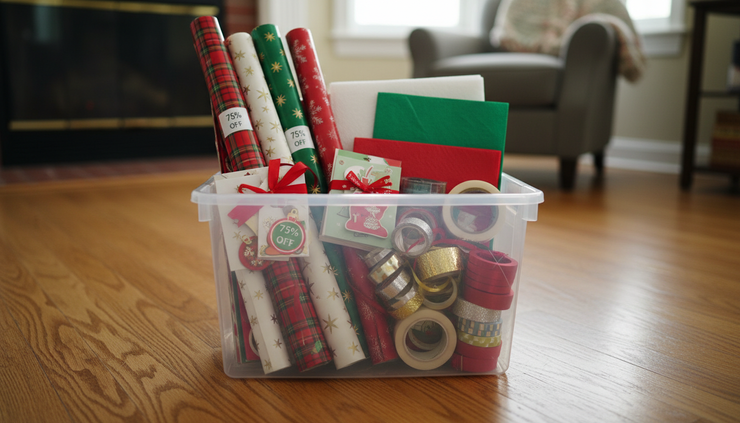
After Christmas, many stores mark down seasonal items. Wrapping paper, gift bags, ribbons, cards, ornaments, lights, and décor often go on sale once the holiday has passed.
That does not mean you should buy everything you see. A sale is only helpful when it fits a real need. But if you know you use certain supplies every year, January can be a smart time to restock.
Good January buys often include:
Neutral wrapping paper that works for Christmas, birthdays, and other occasions.
Gift bags in plain colors or simple holiday designs.
Tissue paper, ribbon, and tape.
Replacement lights or ornaments.
Holiday cards if you send them every year.
Storage bins for decorations and gifts.
Small purchases made early can save you from paying full price later. They also reduce the number of errands you have to run when the season gets busy.
January gives you room to save slowly
A struggling pocket in December often starts in the months before. If every gift, meal, outing, donation, decoration, and travel cost hits at once, even a modest Christmas can feel heavy.
Starting in January gives you the option to save in small amounts.
You might set aside a little money each month in a separate savings account, cash envelope, or digital budget category. The amount does not have to be large to make a difference. The point is to avoid relying on whatever is left over in November.
Even a simple plan can help:
Month | Christmas task | Why it helps |
January | Review last year and write the first list | Keeps fresh details from being forgotten |
February to June | Save a steady amount when possible | Spreads the cost over time |
July | Update the list and start buying selected gifts | Gives time for price checks and thoughtful choices |
August to October | Buy, make, or order gifts gradually | Reduces pressure before the holiday rush |
November | Finish remaining gifts and shipping | Keeps December calmer |
December | Wrap, deliver, host, and enjoy | Leaves space for the season itself |
This is the heart of why it helps to Start Your Christmas List Early in January and July to Save Money and Stress. You are not trying to turn Christmas into a yearlong chore. You are giving yourself breathing room.
What to put on your Christmas list in January
A useful Christmas list starts with people, but it should not stop there.
If your list only includes names, it will still leave gaps. A better list includes budget notes, gift ideas, sizes, preferences, deadlines, and reminders. The more practical your list is, the less you have to carry in your head.
Start with every person and group you normally buy for
Write down everyone you bought for last year. Then add anyone you may need to include this year.
Common categories include:
Immediate family.
Extended family.
Close friends.
Teachers, coaches, caregivers, or service providers.
Neighbors.
Coworkers if your workplace exchanges gifts.
Hosts for holiday parties.
Charity drives, toy drives, or community giving.
Pets, if you like to include them.
This prevents one of the most uncomfortable December problems: realizing you forgot someone and scrambling to find something decent at the last minute.
A forgotten gift can create embarrassment even when the other person is gracious. Starting early helps you avoid that awkward moment entirely.
Add a realistic budget beside each name
A list without a budget can become a wish list with no guardrails.
You do not need to spend the same amount on every person. You also do not need to match what someone else spends on you. The goal is to give within your means and avoid regret later.
For each person, write a target amount. If money is tight, be honest with the number. A thoughtful $15 gift can be better than a $60 gift bought out of pressure.
Budget categories might look like this:
Main gifts for close family.
Smaller gifts for friends or extended family.
Group gifts where several people contribute.
Handmade or baked gifts.
Cards only.
No gift exchange this year.
Setting a limit gives you permission to stop. Without one, it is easy to keep adding “just one more thing.”
Write down gift ideas when they appear
Good gift ideas rarely appear on command. They show up during normal life.
Someone mentions a book they want to read. A child becomes interested in dinosaurs, baking, soccer, or drawing. A friend says their favorite mug broke. A parent talks about needing warm socks, birdseed, or a new puzzle.
If you do not capture the idea, it may disappear.
Keep your list somewhere easy to update. Use a notebook, a notes app, a spreadsheet, or a budgeting app. The best system is the one you will actually use.
Add details when you can:
Clothing sizes.
Favorite colors.
Hobbies.
Allergies or food preferences.
Home décor style.
Books or games they already own.
Stores they like.
Things they have specifically said they do not want.
These notes turn early planning into better gift giving. You are not just saving money. You are paying attention.
Why July is your second best planning month
July may feel like the opposite of Christmas. The weather is warm, kids may be out of school, and holiday music is nowhere in sight. That distance is useful.
By July, half the year has passed. You can see what has changed, who needs to be added, and whether your budget is on track. You also still have enough time to make smart decisions before the holiday rush begins.
Think of January as the planning month and July as the action month.
July helps you catch life changes
A lot can happen between January and July.
New babies are born. People move. Children grow into new interests. Families blend. Friendships shift. A niece who loved dolls in December may now only care about science kits. A relative may downsize and prefer consumable gifts instead of more stuff.
Your July check-in keeps your list current.
Review each name and ask:
Is this person still on the gift list?
Has their life changed since January?
Has their taste or hobby changed?
Do I need to mail this gift?
Is there a birthday, wedding, baby shower, or graduation affecting my budget too?
Can a group gift make more sense?
This step prevents waste. It also prevents the heartache of giving a gift that feels disconnected from the person receiving it.
July gives you time to compare prices
Last-minute shopping steals your ability to compare.
When you shop in late December, your choices shrink. Popular items may sell out. Shipping may cost more. Stores may be crowded. You may choose convenience over value simply because you are tired.
In July, you can watch prices and wait for a fair deal. Many retailers run summer sales, clearance events, and back-to-school promotions. You do not need to buy everything in July, but you can start buying items that make sense.
Good July purchases often include:
Books.
Board games and puzzles.
Craft supplies.
Kitchen tools.
Clothing basics if sizes are predictable.
Hobby items.
Gifts for adults whose tastes do not change much.
Items you know rarely go out of season.
Be careful with gifts for young children, especially if their interests change quickly. A toy bought in July might be perfect, or it might be old news by December. For kids, focus on timeless items or wait until closer to the holiday.
July is perfect for handmade gifts
If you like to make gifts, July is your friend.
Handmade items take time. So do photo books, quilts, knitted scarves, custom ornaments, recipe collections, and family memory projects. Waiting until December turns these gifts into stress. Starting in July makes them enjoyable.
July also gives you room to gather materials slowly. You can buy yarn, jars, frames, ingredients, or craft supplies when they are on sale. You can work on the gift in small sessions instead of staying up too late in December trying to finish.
Handmade gifts are often the ones people remember most. They deserve time.
How early planning saves money without making Christmas feel cheap
Some people resist early planning because they worry it will make gift giving feel cold or overly controlled. That does not have to happen.
A budget does not remove generosity. It protects it.
When money is planned, you can give without resentment. You can choose gifts with care instead of panic. You can enjoy the season instead of counting every receipt with dread.
You stop buying out of guilt
December has a way of making everything feel urgent.
You may feel guilty for not spending enough. You may feel pressured when someone gives you an unexpected gift. You may buy extra items because a gift looks too small once it is wrapped. You may spend more because you are tired and want the decision to be over.
Early planning helps you separate generosity from guilt.
When you already know your budget and your gift plan, you are less likely to panic buy. You can still adjust, but you are not starting from chaos.
A helpful rule is to decide what “enough” looks like before you shop. For example:
One main gift per child.
One shared family gift.
Stockings with useful items only.
Baked goods for neighbors.
Cards for extended contacts.
A set dollar amount for each exchange.
Once you define enough, you can stop adding to the pile.
You avoid expensive shipping mistakes
Shipping is one of the easiest ways to waste money during the holidays.
Late ordering can lead to faster shipping fees. Delayed packages can force you to buy backup gifts. Mailing gifts at the last minute can make the whole process more stressful than it needs to be.
An early list lets you mark who needs a mailed gift. Buy or make those gifts first. Wrap and ship them before the rush if possible. Even if you do not mail anything until November, knowing your shipping list early helps you avoid surprises.
This matters even more if family and friends live in different states. Nationwide gift giving adds time and cost. Planning early gives you more control over both.
You can use rewards, store credit, and gift cards wisely
Many people have small pockets of value they forget about until too late.
A store credit from a return. A gift card in a drawer. Cash-back rewards. Loyalty points. A coupon for a store you already use. These can help cover Christmas costs if you plan ahead.
The danger is using rewards as an excuse to overspend. Treat them as part of the budget, not a reason to go beyond it.
For example, if you plan to spend $40 on a gift and have a $10 store credit, spend around $30 out of pocket. Do not turn that into a $60 gift just because the discount made it feel cheaper.

How early planning prevents heartache and embarrassment
Money matters, but it is not the only reason to start early.
The holiday season carries emotion. Gifts can remind people that they are known, seen, and loved. They can also expose tension, forgetfulness, or lack of thought. Most people do not expect perfection, but rushed giving can still hurt.
An early list gives relationships more care.
You remember the people who are easy to overlook
Some of the most meaningful gifts go to people who are not the loudest names on the list.
A neighbor who checks on your house. A teacher who encouraged your child. A family member spending their first Christmas alone. A friend who has had a hard year. A caregiver who shows up faithfully.
When you plan late, those people can slip through the cracks. When you start early, you have time to think beyond the obvious.
You do not have to buy expensive gifts for everyone. A handwritten card, homemade cookies, a framed photo, or a small practical item can carry warmth. The key is remembering before the season becomes too crowded.
You reduce awkward last-minute exchanges
Few holiday moments feel more uncomfortable than receiving a gift when you have nothing to give in return. It happens. It is not the end of the world, but it can feel embarrassing.
A January list helps you note who gave you a gift last year. A July review helps you decide what to do this year. You may choose to add that person to your list, suggest no exchange, or prepare a few simple extra gifts.
“Emergency gifts” can be useful, but they should still feel thoughtful. Good options include:
A nice candle in a neutral scent.
A box of quality tea, coffee, or cocoa.
A small local food item.
A puzzle book.
A cozy pair of socks.
A simple holiday ornament.
A handwritten card with a small treat.
Keep extras modest and easy to store. The point is not to build a gift bunker. It is to avoid panic.
You make room for people going through hard seasons
Early planning also helps you respond with care when someone’s year has been difficult.
A family member may be grieving. A friend may be out of work. A neighbor may be dealing with illness. A child may be adjusting to a big move. In these cases, the best gift may not be flashy. It may be practical, comforting, or personal.
When you are rushed, you may miss the chance to give well. When you plan early, you can choose with more heart.
That might mean a meal delivered in December, a framed photo of someone they miss, help with decorations, a low-key invitation, or a gift card that covers a real need.
The most thoughtful gifts often come from listening over time.
A simple system for building your Christmas list
Your system does not need to be fancy. A basic notebook can work as well as a spreadsheet. What matters is that the list is easy to update and easy to find.
If the system is too complicated, you will avoid it. Keep it simple enough to use in five minutes.
Choose one place for the list
Do not scatter gift ideas across sticky notes, text messages, screenshots, and memory. Pick one home for the list.
Good options include:
A paper notebook kept with your planner.
A notes app on your phone.
A spreadsheet.
A budgeting app.
A shared document for couples or families.
If more than one adult manages Christmas shopping, use a shared list. That prevents duplicate gifts and missed names.
Use clear columns or categories
A practical list should show more than gift ideas.
Try categories like these:
Person | Budget | Ideas | Bought | Wrapped | Delivered |
Parent | $50 | Garden gloves, bird feeder, mystery novel | |||
Child | $75 | Art supplies, hoodie, science kit | |||
Neighbor | $15 | Cookies, cocoa mix, card |
You can make this more detailed if you like, but do not overbuild it. The goal is to see what still needs attention.
The `Bought`, `Wrapped`, and `Delivered` columns are especially helpful in November and December. A gift sitting in a closet is not finished if it still needs batteries, wrapping, or mailing.
Add a hiding place note
Buying early creates one funny problem: forgetting where you hid things.
Add a simple note for where each gift is stored. Use a phrase only you understand if privacy matters. For example, “top closet bin” or “blue tote.”
This prevents the classic December problem of finding a perfect gift in March of the next year.
Keep receipts together
Early buying works best when you can handle returns or exchanges. Store receipts in one envelope, folder, or digital album.
For gifts bought far in advance, check return windows before purchasing. Some items may not be returnable months later. That does not mean you should never buy early, but it does mean you should be more careful with sizes, electronics, trendy toys, and anything with a short warranty or return period.
What to buy early and what to leave until later
Early Christmas planning does not mean buying every gift in January or July. Some gifts are safe to buy months ahead. Others are better left until closer to the holiday.
The trick is knowing the difference.
Buy these early when the price is right
Some items hold their value and usefulness over time. These are often good early purchases:
Wrapping supplies.
Holiday cards.
Books.
Classic toys.
Board games.
Puzzles.
Craft kits.
Kitchen items.
Tools.
Candles.
Blankets.
Ornaments.
Nonperishable gift basket items with long expiration dates.
Supplies for handmade gifts.
These gifts are less likely to become outdated before December.
Wait on items that may change
Some gifts carry more risk if bought too early.
Be careful with:
Clothing for growing children.
Shoes.
Trend-based toys.
Electronics that may drop in price or get updated.
Food with expiration dates.
Beauty items with specific preferences.
Event tickets unless the date is confirmed.
Anything the recipient may buy for themselves first.
For these gifts, use your early list to plan, not purchase. Note the idea, set the budget, and choose the best buying window later.
Watch out for overbuying
Early shopping can save money, but only if you stay disciplined. The danger is buying a “great deal” every time you see one and ending up with too much.
A full closet of random gifts can become its own kind of waste.
Before buying early, ask:
Is this for a specific person?
Does it fit the budget?
Would I buy it if it were not on sale?
Do I have a place to store it?
Will it still make sense in December?
If the answer is no, leave it.
A bargain that creates clutter or debt is not a bargain.

How to talk about gift limits before the season gets tense
One of the best ways to save money and stress is to talk about expectations early.
Many families keep overspending because no one wants to be the first to suggest a change. By December, the conversation feels awkward. In January or July, it feels more practical.
You can suggest simpler plans without making anyone feel blamed.
Offer clear, kind options
If gift exchanges have become too expensive, suggest a new structure.
Ideas include:
Draw names instead of buying for every adult.
Buy only for children.
Set a spending cap.
Give experiences instead of physical gifts.
Do a potluck meal instead of expensive hosting.
Choose handmade gifts.
Skip gifts and plan a shared outing.
Donate together to a cause the family cares about.
Keep the tone warm. The goal is to make the holiday better, not to scold anyone for past spending.
You might say, “I’d love to make Christmas less stressful this year. Would everyone be open to drawing names for adults and keeping the focus on the kids?”
That gives people room to agree, adjust, or suggest a different idea.
Set boundaries before you shop
Once expectations are clear, shopping gets easier.
If your family agrees to a $25 limit, you can ignore gifts outside that range. If friends agree to skip gifts, you can enjoy time together without the pressure to exchange bags. If adults draw names, you can choose one better gift instead of many small ones.
Boundaries make generosity more peaceful.
They also reduce resentment. No one wants to start the new year regretting what they spent in December.
How to keep the list from becoming another source of stress
A Christmas list should make life easier. If it starts to feel like a burden, simplify it.
The goal is not perfection. The goal is fewer surprises, better choices, and a calmer season.
Schedule two short check-ins
You do not need to think about Christmas every week.
Try two main check-ins:
One in January to review and set the list.
One in July to update and start action.
Then do light maintenance as ideas appear. If someone mentions a gift idea in April, add it. If you buy something in September, mark it. That is enough.
A list that takes ten minutes to update is more useful than a perfect system you never open.
Give yourself a stopping point
Many people overspend because they never declare the shopping finished.
Create a stopping point. It might be a date, a budget limit, or a completed checklist.
For example:
All shipped gifts must be ready by Thanksgiving weekend.
All gifts must stay within the total Christmas budget.
Stockings stop when each one has five items.
No new gifts after December 15 unless something truly necessary comes up.
A stopping point protects your peace.
Leave space for joy
Planning early does not mean removing spontaneity. There is still room to enjoy a holiday market, pick up a fun ornament, or bake cookies with family.
The difference is that those choices become enjoyable extras, not desperate fixes.
When the basics are handled early, December can hold more of what people actually love: lights, music, worship, rest, family meals, movies, giving, and quiet moments that do not cost much at all.
Start small this year and let the habit grow
If you have never started a Christmas list early, do not try to build the perfect system all at once.
Start with one simple step.
In January, write down everyone you bought for last Christmas and what you remember spending. Add anyone you forgot or nearly forgot. Put the list somewhere you will find it again.
In July, open the list. Update names, set budgets, and choose a few gifts to buy or make ahead. Restock wrapping supplies if needed. Check your savings. Talk with family about gift limits before the season gets crowded.
By November, you will feel the difference.
You may still have things to do. You may still buy a few gifts late. Life happens. But you will not be starting from zero. You will not be carrying the whole holiday in your head. You will not be forced to choose between thoughtfulness and what your pocket can handle.

Christmas has a way of arriving faster than expected. January and July give you two chances to get ahead of it.
Use January to remember. Use July to prepare. Give yourself time to save, shop, make, wrap, ship, and care.
A calm Christmas rarely happens by accident. It usually starts with a simple list, written long before the rush begins.


Comments